
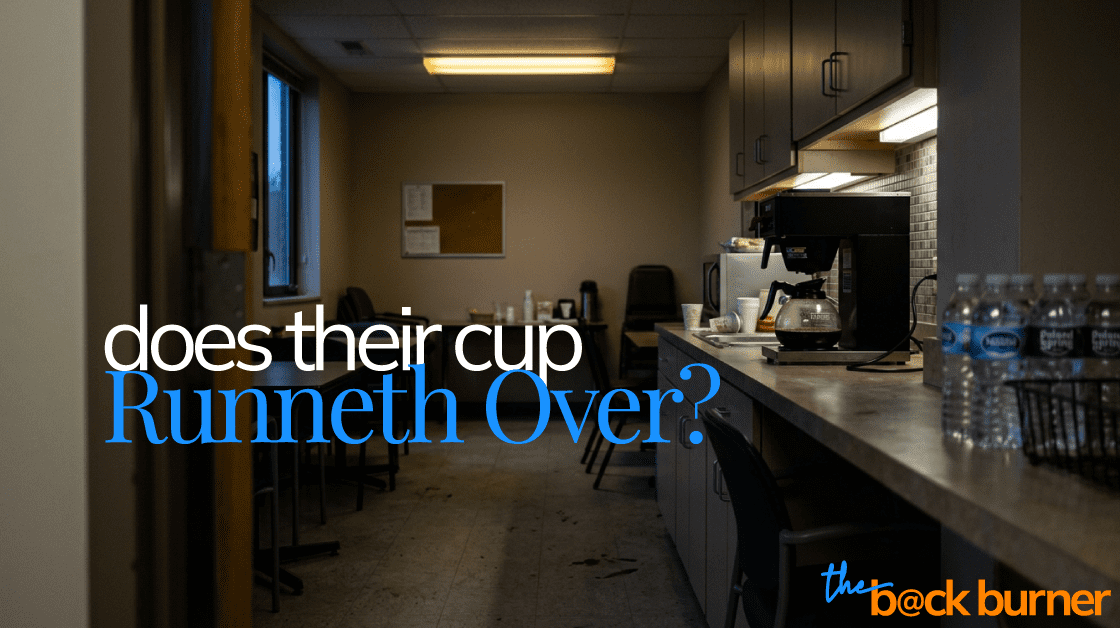
I’m betting there is a pot of coffee in your break room right now.
Maybe it is fresh. Maybe it has been sitting on the burner since before the morning standup and some well-intentioned co-worker keeps meaning to make a new pot but the day keeps happening. Either way, it’s there. It’s always there. Because that is what coffee does – it’s reliable. It fuels the team; it absorbs whatever the morning throws at it – but it also gets burned sometimes and overflows other times. Frequently, it just ends up empty.
Your core team is that coffee. Not because they grind – although I’m sure they do – but because they’re there. They’re showing up day after day.
Reliable. Familiar. The “go to” that everyone reaches for without thinking. And here is the part nobody wants to say out loud: even great coffee turns cold when nobody’s paying attention. Not because it is bad coffee. Because that is what happens when something good gets pushed past its limits, goes unnoticed, or taken for granted. As a modern-day pop-poet may quip, is your team “starting to feel just a little abused, like a coffee machine in an office?”
The Team Is Great. And That Is Exactly the Problem.
The most common thing I hear from business leaders who are running their teams into the ground is not “our people are struggling.” It is the opposite. It is “our team is incredible – they always find a way.”
And they mean it as a compliment. I understand that. But I have watched enough organizations operate beyond full capacity for long enough to know what that sentence is usually covering for.
“They always find a way” is sometimes code for: we have been pouring more into this pot than it was designed to hold, and nobody has stopped to ask what that costs. The team finds a way because the team is good. But good is not the same as infinite. And the best people – the ones you most depend on – are usually the ones absorbing the most overflow without saying a word about it.
Research confirms what most operators already feel in their gut: roles have expanded as reductions in headcount rarely come with a reduction in responsibilities. The work grows. The team stays the same size. And somewhere in that gap, the strategic work starts losing to the urgent work every single day.
That burnt coffee smell? That empty pot? That is not a coffee problem. That is a system problem.
Maybe They Just Need a Refill.
Here is where most organizations get stuck. The coffee is burning, the team is stretched, and the instinct – almost every time – is one of two things: a refill or a new cup.
A refill or top-up is just pouring in more, asking the team to push through and absorb the problem. Again. Because they always do. Until they do not.
A new cup is a new hire. That means opening a requisition, running a search, interviewing candidates, onboarding someone new, and hoping the role you defined three months ago still matches the need by the time someone starts. Nearly 60% of companies reported that time-to-hire increased in 2025 – which means the gap the new hire was supposed to fill just kept getting wider while the process ran its course.
But sometimes the team does not need more coffee. Sometimes the moment calls for something different – a specific skill, a defined project, a particular kind of expertise that your core team does not have and does not need permanently. And we haven’t even gotten to flavored coffee, specialty roasts, pour-overs – or come to terms with the fact that half the team is grabbing a gas station varietal on the way in anyway.
Here’s the Tea.
Sometimes you need tea. Other times soda. Tea and soda do not replace coffee. Options serve different needs at different moments. The person who considers – or recommends – an alternative is not failing the coffee. They are just being honest that the situation calls for something the coffee was never designed to provide.
That is what great freelance talent does when it is matched right. Not showing up to take over, they show up to handle the specific thing – the campaign launch, the product sprint, the content backlog, the research project – that your core team either cannot get to or should not be pulled away from their primary work to tackle. Flexible talent fills the gap without disrupting what is already working.
Maybe you need a generalist who, like water, acts as a foundational resource and helps with the day-to-day heavy lifts. Maybe you need one well-trained contractor to support the existing team for a defined period. Or maybe you need a hyper-specialized, heavily modified latte with added shots, pumps of syrup, and a dramatic milk alternative – someone with a skill set your team has no experience with, but the freelancer can brew up a venti-sized serving of high-energy, successful forward motion.
And Sometimes You Just Need Water.
Now here is the part that tends to surprise people.
Coffee is great. Tea is great. But when you are genuinely depleted – not just tired, not just busy, but running on fumes at a structural level – what your team actually needs is the most fundamental thing. Not the most sophisticated solution. Not the most complex hire. Just the right resource, doing the right work, delivered cleanly and without drama.
Water does not have a flavor profile. It does not require a French press, a steep time, or a foam layer. Water hydrates. It restores. It does the essential work that makes everything else possible.
There is a reason every other beverage on the planet is built on a foundation of water. Coffee needs it. Tea needs it. Even the soda in the vending machine down the hall is mostly water. Strip away the complexity and the specialized ingredients and you get back to the thing that actually sustains everything else.
Flexible talent – matched well, deployed intentionally – works the same way. It is not always the glamorous solution. It does not always come with a headline. But it is the thing that lets your core team breathe again. It is the resource that does not ask your best people to keep absorbing work they do not have the hours to absorb. It fills the gap at the foundation so everything built on top of it can function the way it was designed to.
Fill the gaps, not just the seats. That is not a staffing philosophy. That is an organizational one.
The Back Burner Is Not a Strategy.
I want to be direct about something, because I think it gets glossed over in most conversations about team capacity.
Leaving good people on the back burner – telling yourself the team will get to it, that they can handle it, that the moment will pass – is a choice. It doesn’t feel like a choice in the moment. It feels like the only option. But it is a choice, and it has a cost that most organizations are paying without ever adding it up.
The research is consistent: chronic overextension takes a significant toll on employee well-being, leading to decreased engagement and increased turnover. The people most likely to leave are the ones who have been quietly holding the most weight. And when they go, they take institutional knowledge, client relationships, and momentum with them – none of which show up as a line item until they are already gone.
The back burner keeps the coffee warm. It does not make it better. At some point, someone needs to make a fresh pot – and maybe while they are at it, chill some water bottles too.
What the Right Match Actually Looks Like.
I have seen what happens when a team brings in the right flexible talent at the right moment. Hiring does not have to look like a staffing transaction. It looks like relief, like movement – the project that had been stalled for six weeks is suddenly moving. The marketing director who had been doing three jobs gets to focus on one again. It looks like the leadership team making strategic decisions instead of just managing the overflow.
That outcome does not happen by accident. It happens when the match is made thoughtfully – when someone takes the time to understand not just the role but the team, the culture, the actual definition of done. A great freelancer who lands in the right environment does not feel like an outside resource. They feel like exactly what was needed. Because they are.
The coffee is still brewing. Your core team is still the foundation. But the smartest organizations I know have stopped pretending that coffee alone is a complete hydration strategy.
Sometimes you need water. And knowing when to reach for it – before the cup runs dry – is one of the better leadership decisions you can make.

Chris is the President & COO of FlexTal. He brings 20+ years of experience in Customer Success, UI/UX, design, and marketing – including time within start-ups, agencies, and enterprise orgs. Chris has also served as a University adjunct professor in Advertising & Public Relations for several years.