
Category

Hiring Strategy

Does Their Cup Runneth Over?

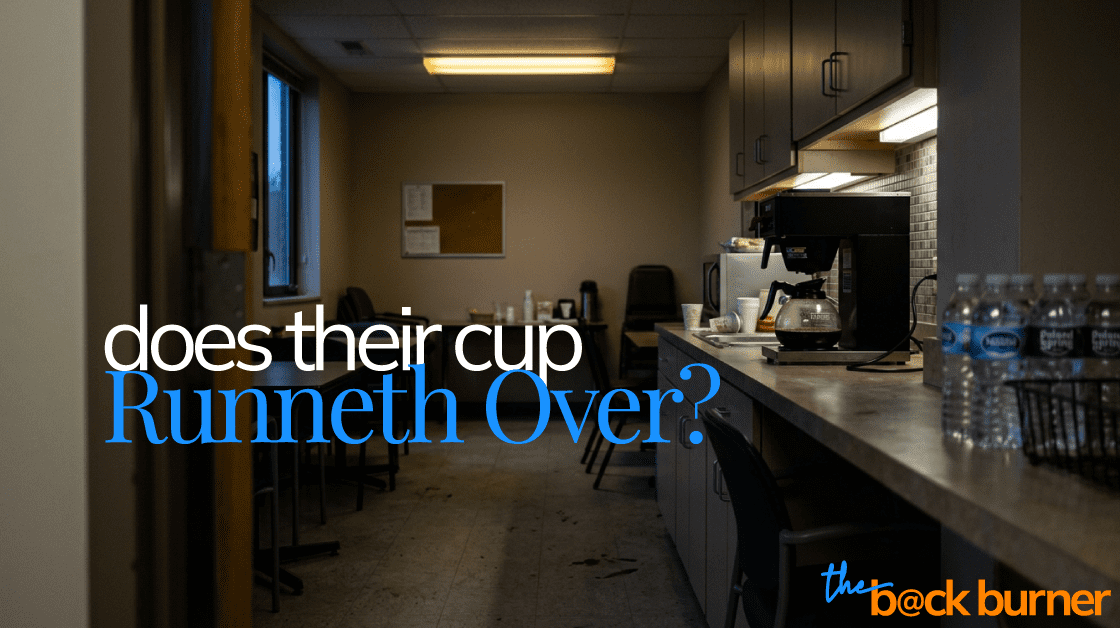
a photograph of an office break room with a nearly empty coffee pot on the counter. The break room looks shabby and unattractive, highlighting that the team is at capacity.

I’m betting there is a pot of coffee in your break room right now.

Maybe it is fresh. Maybe it has been sitting on the burner since before the morning standup and some well-intentioned co-worker keeps meaning to make a new pot but the day keeps happening. Either way, it’s there. It’s always there. Because that is what coffee does – it’s reliable. It fuels the team; it absorbs whatever the morning throws at it – but it also gets burned sometimes and overflows other times. Frequently, it just ends up empty.

Your core team is that coffee. Not because they grind – although I’m sure they do – but because they’re there. They’re showing up day after day.

Continue Reading

Chill. We’ve Been in Your Corner – You Just Didn’t Know It.

The word "Chill." Written in a handwriting font in white on a blue field.

There’s a specific kind of exhaustion that sets in at week five of any project that was planned – and budgeted – for three. It’s not dramatic. It doesn’t announce itself. It just settles in quietly – in the fourth rescheduled deadline, the apologetic client email you draft and redraft, the Sunday afternoon you spend doing the work that Friday afternoon was supposed to hold. You’re not failing. You’re just running a marathon that started as a sprint, but kept getting longer while you continued running it – and doing it without the freelance talent support that could have made all the difference.

Most people push through. They redistribute the load, lean into the team, ask too much of the people who can least afford to give more, and eventually deliver something that’s good enough but not what it was supposed to be. Then they take a breath, declare it a win, and quietly file the whole experience under “that was rough” – without ever stopping to ask why it had to be rough in the first place.

That question, “why?” is worth asking. Because the answer, almost every time, is the same: there wasn’t enough flexible talent support in the room when the walls started closing in.

Continue Reading

Asynchronous Collaboration Strategies That Actually Work

a photograph depicts asynchronous collaboration strategies. Showing a woman sitting at a desk taking notes while also looking at her laptop monitor and external display. her laptop shows a video-chat app, her other monitor displays a graph. The room filled with natural light from windows has plants, books, and a lamp in the frame.

There’s a particular kind of chaos that sets in around day three of managing a remotely distributed team.

You ping your designer in Istanbul at 8 AM your time. She’s already wrapped up for the day. Your developer in Portland won’t be online for another four hours. Your content strategist in Austin just sent eleven voice memos – all of them important, none of them short. And you’re sitting there, the supposed orchestrator of this whole operation, wondering how anyone gets anything done when everyone’s clocks are pointing in different directions.

Continue Reading

The Invisible Ceiling: What to Do When Your Core Team Has Nothing Left to Give

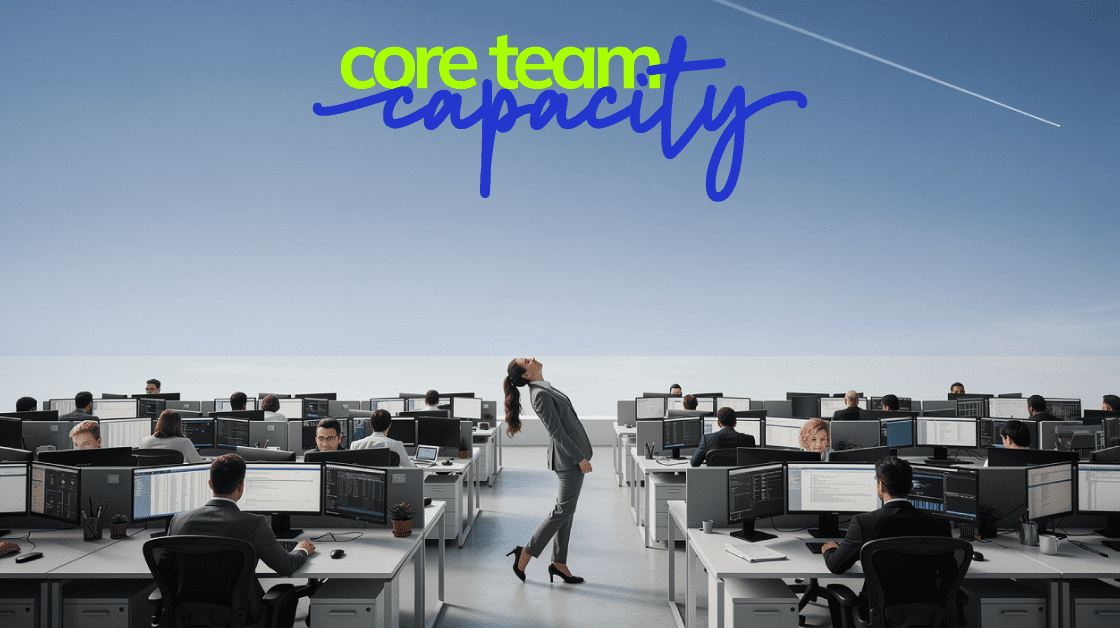
A woman walks with a strange lean through an office space that seems to have an invisible ceiling - illustrating the concept of a core team capacity being reached by hitting an invisible ceiling.

There’s a particular kind of organizational dysfunction that doesn’t announce itself. It doesn’t show up in a boardroom slidedeck or trigger a crisis meeting. It moves quietly – through the organization, through the people, through the work – until one day you look around and realize that your best people are exhausted, your timelines have gotten optimistic in a way that no longer means anything, and the quality of output has drifted just enough that you’ve started wincing at things you used to feel proud of.

This is what hitting core team capacity actually looks like. It’s an invisible ceiling – an unseen, but all too real cap on capacity. Not a dramatic meltdown. A slow, grinding erosion.

Continue Reading

Skill Gaps vs Capacity Gaps

Illustration of two orange human figures; the one on the left is juggling four icons that represent skills, the one on the right is juggling several circles that represent capacity. Each figure is juggling one empty item. The illustration reinforces the idea of skill gaps vs. capacity gaps.

There’s a moment most business leaders know all too well. A project stalls. The deadline starts looking less like a target and more like a double-dog-dare. The roadmap for one product sits untouched while the team sprints on other fires. The instinct is immediate and almost universal: we need more people.

But more people doing what, exactly? And what kind of people – and for how long?

Continue Reading

The Hybrid Team Model Works. Here’s Proof.

photo of 3 people working on different devices at the same table. Overlay of text says, "the hybrid team model works."

There’s a quiet revolution happening inside some of the world’s most competitive companies – and it doesn’t involve a rebrand, a pivot deck, or a ping-pong table that nobody actually uses. It’s something far more practical: the best operators have stopped treating their workforce as a binary choice. Full-time or contractor. Headcount or outsourced. Instead, they’ve built something more deliberate – a hybrid team model that blends permanent staff with specialized freelance talent in a way that’s strategic, not accidental. The result is a workforce that’s more agile, more cost-effective, and far better equipped to handle the actual shape of modern business demand.

Once you see how well it works, it’s genuinely hard to justify going back to the old way.

Continue Reading

Reliability in the Workplace is the Real MVP

Four men in business suits play basketball in a stadium filled with spectators. Two men wear gray suits, two men wear blue. One player is shown assisting the other depicting reliability in the workplace.

There may be no more underestimated driver of performance than reliability in the workplace.

Skills matter. Strategy matters. Talent certainly matters. But without consistency, none of those strengths sustain momentum for long. Reliability in the workplace is what turns strong ideas into executed plans and promising hires into trusted contributors. It is the invisible infrastructure holding everything together.

It does not sparkle. It rarely gets applauded in all-hands meetings. No one throws a parade because someone delivered what they said they would deliver on Tuesday at 3:00 p.m. by Tuesday… at 3:00. And yet, when reliability disappears, everyone notices immediately.

Because work that looks impressive and work that actually works are two very different things.

Continue Reading

The Future of Work Won’t Be Hired – It Will Be Built

an illustration of a "now hiring" sign with the word "hiring" crossed off and the word "building" written in handwriting. The sign is white and orange, the handwritten word is light blue.

When you think about HR, you might picture the friendly gatekeepers of policies and payroll – the folks behind your benefits packet, the annual compliance training, and the arbiter of office drama that feels a lot like high school and leads to that team-building retreat with the cake-made-out-of-rainbows-and-smiles trust falls (“she doesn’t even go here!”). But the modern HR function is no longer just “keeping the lights on” in the people department. Today’s HR teams are part detective, part architect, and part business strategist – navigating a workplace that’s evolving faster than anyone could’ve predicted. HR is changing – and leaders must now update the very definition of what it means to build a team.

Because here’s the truth: the future of work won’t be hired – it will be built.

Continue Reading

Is the Résumé Dead? Long Live Skills-Based Hiring

image of a human juggling icons that represent skills. The figure is orange, the icons are an orange gear, blue check-mark, and orange and blue wrench and pencil.

Remember when hiring managers used to swoon over Ivy League degrees? These days, they care more about who can stop the app from crashing or make sales spike. Welcome to the era of skills-based hiring – where knowing how to get things done beats knowing where you learned it. Because while diplomas look great in a frame – and make for polite conversation starters when viewed in your Zoom background – results look even better on a balance sheet.

Continue Reading