
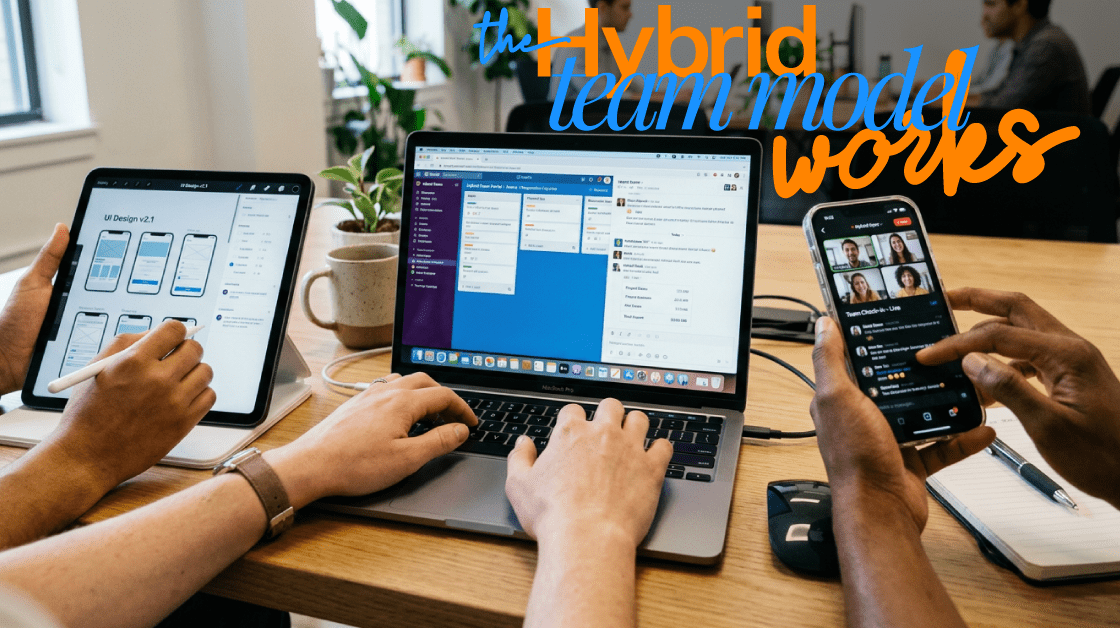
There’s a quiet revolution happening inside some of the world’s most competitive companies – and it doesn’t involve a rebrand, a pivot deck, or a ping-pong table that nobody actually uses. It’s something far more practical: the best operators have stopped treating their workforce as a binary choice. Full-time or contractor. Headcount or outsourced. Instead, they’ve built something more deliberate – a hybrid team model that blends permanent staff with specialized freelance talent in a way that’s strategic, not accidental. The result is a workforce that’s more agile, more cost-effective, and far better equipped to handle the actual shape of modern business demand.
Once you see how well it works, it’s genuinely hard to justify going back to the old way.
The Model That Served Us Well (Until It Didn’t)
For decades, growing a team was pretty straightforward: identify a need, write a job description, hire someone, repeat. Headcount was the primary metric of organizational scale. If demand grew, you hired. If it shrank, you had an uncomfortable conversation with HR and a few people carried cardboard boxes to their cars.
The problem isn’t that this model was wrong – it’s that business no longer moves in the straight, predictable lines it once did. A company might need a specialized UX researcher for one quarter, a data engineer for a product launch, and a compliance expert for six weeks during an audit cycle. Hiring full-time for each of those roles isn’t just expensive; it’s often logistically impossible given how long proper hiring cycles actually take. And once you’ve made those hires, the work doesn’t always sustain them.
The hybrid team model exists precisely to solve this. You maintain a core permanent team that carries your culture, your institutional knowledge, and your long-term strategic direction. Then you layer in specialized freelance talent exactly when and where the work demands it – without the overhead, the 90-day onboarding gauntlet, or the awkward “we’ve restructured… again” conversation when the project wraps.
What Leading Organizations Already Figured Out
This isn’t a theoretical framework being workshopped at a business school. The companies that have quietly mastered the hybrid team model have been doing it for years.
Google’s extended workforce – internally called TVCs, for temps, vendors, and contractors – has at various points outnumbered its permanent employee base. That’s not a cost-cutting measure. It’s a structural decision that gives the company access to specialized expertise on demand without locking it into permanent headcount commitments for work that is, by nature, project-based. According to reporting from The New York Times, this shadow workforce has long been a core part of how Google scales.
Unilever made public commitments to building what they call a more “agile” workforce, treating freelance and flexible talent as a strategic resource – particularly in creative, digital, and innovation functions where the speed between idea and execution matters most. Their thinking is documented in detail through the World Economic Forum’s Future of Jobs research, which consistently identifies workforce flexibility as a defining competitive advantage across industries.
And this isn’t just a story about giants with infinite resources. Mid-market companies in fintech, healthcare, e-commerce, and professional services have found that some of their highest-impact work happens when a sharp, cohesive full-time team is augmented by a specialist who has solved this exact problem two dozen times before – and can deliver without months of ramp-up.
Knowing What Belongs Where
One of the most important – and underappreciated – aspects of the hybrid team model is the discipline to know what shouldn’t be freelanced.
Your full-time team carries something that can’t be easily transferred: context. Your core team knows why you made a particular product decision eighteen months ago. They understand the actual risk tolerance of your leadership team. Long-term, full-time staff can read the room in a way that takes time to earn, and that institutional memory is the foundation everything else gets built on. Continuity of culture and strategy belongs with your permanent team. That’s not a philosophical point – it’s a practical one.
Freelancers bring something different, and often something your permanent staff can’t realistically provide: deep specialization and fresh perspective. A freelance data scientist who has spent three years working exclusively on customer churn models isn’t going to need six months to understand your problem. They’ve seen the shape of it before. They know which variables matter, which approaches tend to fail, and where the interesting work actually lives.
So the decision framework stops being “hire or don’t hire” and becomes something more nuanced: is this a core function that requires continuity, cultural ownership, and long-term investment? Or is this a defined, specialized need with a clear scope and a finish line? The first category belongs to your permanent team. The second is where freelance talent genuinely excels – and where the hybrid team model creates the most value.
Where Most Companies Get a Blended Workforce Wrong
Here’s what doesn’t get talked about enough: the hybrid team model only works if you manage it with intention. And most companies don’t.
Too many organizations bring in freelancers and then treat them like a mysterious third category – not quite employees, not quite vendors, somewhere in between and not quite sure where to point them. That’s a recipe for underperformance. Not because the talent isn’t there, but because the conditions for success aren’t. A freelancer who isn’t connected to the right stakeholders, given real project clarity, or integrated into the team’s communication channels will struggle – regardless of how talented they are.
The companies that get this right do a few things consistently. They integrate freelancers into the tools and communication channels the team actually uses, from day one. They assign a clear internal point of contact who can answer questions and remove blockers without delay. And they treat scope definition as non-negotiable – because a well-briefed specialist is a high-performing specialist, and vague project parameters are the fastest way to burn budget without results.
The management investment required for a well-run hybrid team is real. But it’s considerably less than the cost of a wrong full-time hire – and far less than the cost of a critical initiative stalling because the right expertise wasn’t available when the window was open.
The Financial Case (Which Is Hard to Argue With)
The strategic benefits of the hybrid team model are compelling on their own. But the financial math adds another layer that’s genuinely hard to dismiss.
The fully-loaded cost of a full-time employee – salary, benefits, payroll taxes, equipment, onboarding time, and the real cost of getting a bad hire wrong – routinely exceeds what appears in any hiring budget. For roles that are project-based, highly specialized, or seasonal in nature, you’re frequently paying for expertise that’s only fully engaged 40 to 50 percent of the time. The rest is overhead.
Freelancers flip that equation. You pay for the work that exists, when it exists. The specialized talent that would represent a $160,000-plus annual commitment as a full-time hire might be a focused $12,000 engagement for a defined project scope – and you get the expertise without the long-term financial obligation. Research from McKinsey & Company on the future of work consistently identifies this kind of flexible resourcing as one of the structural advantages of adaptive organizations.
None of this means freelancers are always the cheaper answer. For roles requiring a full-time commitment, 40-hour a week availability, or indefinite organizational collaboration, an internal hire may not just make more sense – it might be a mandate. Sometimes even a federal tax employment requirement or employer responsibility. But for the significant portion of work that doesn’t fit that description, the hybrid model offers financial flexibility that a purely permanent workforce simply can’t match.
The Talent Access Argument
Cost and efficiency tend to dominate the conversation around the hybrid team model – and when they do, most people overlook a third dimension entirely: access.
Some of the most valuable expertise in any industry doesn’t live on anyone’s payroll. Senior strategists, niche technologists, specialized researchers, experienced creative directors. People with rare skill sets and deep domain knowledge often choose to work independently, on projects they find interesting, with a variety of clients. They’re not available to hire. But they are available to engage.
A hybrid team model creates the conditions to access that talent. And in industries where months of runway or millions in product investment separate a good solution from the right one, that access delivers a genuine competitive advantage – not a nice-to-have.
Building a Hybrid Team Strategy… With Purpose
The companies that benefit most from the hybrid team model don’t stumble into it. They make deliberate decisions about how to source and integrate freelance talent. More importantly, they invest in building the right infrastructure to do it consistently without it becoming a project in itself every single time.
That last part is where a lot of organizations quietly struggle. The first engagement goes well. The second requires rebuilding the process from scratch. By the third, someone is asking whether this is actually saving time or just redistributing the effort. The problem isn’t the model – it’s the absence of a reliable, repeatable way to execute it.
The Partner Who Holds the Playbook
What changes that equation is having a contingent workforce solutions partner who actually learns your business. Not just your job descriptions, but your culture, your pace, your standards, and the particular way your team works best. When that understanding is in place, the process of bringing in the right specialist for a new need stops feeling like a procurement exercise and starts feeling like a phone call. You simply describe what you’re trying to accomplish. Then the work of finding the right match – vetting, scoping, calibrating experience level – happens on someone else’s side of the table.
That’s the consistency the hybrid model needs to be truly sustainable. Not a Rolodex of individual contractors you’ve worked with before, but a relationship with a partner who holds that institutional knowledge on your behalf and puts it to work every time a new need surfaces. The heavy lift moves off your plate. The quality stays high. And the team you build – project by project, engagement by engagement – reflects a coherent strategy rather than a series of one-off searches.
FlexTal builds everything around exactly this dynamic. Each company works with a dedicated Customer Success Manager (CSM). That CSM develops a real understanding of the business over time, using that context to match the right talent from a curated network. Quickly. Without the friction that typically slows these decisions down.
The Workforce Is Different, Is Your Strategy?
The best teams aren’t the biggest ones. They’re the ones assembled with purpose – built around a strong, stable core and expanded with exactly the right expertise at exactly the right moment.
That’s the real promise of the hybrid team model. Not as a cost-cutting workaround, and not as a hiring shortcut, but as a legitimate strategic framework for building organizations that can actually keep up with the pace of modern business. The companies that have figured this out aren’t in a hurry to give it up. And the ones still operating on the old model are starting to feel the gap.
The workforce is different now. Your strategy should be too… is it?

FlexTal is the #1 flexible talent matching platform. Every day, we match organizations with pro-level independent contractors for flexible hourly and project-based engagements. Match with the Right Pro, Right Now.