
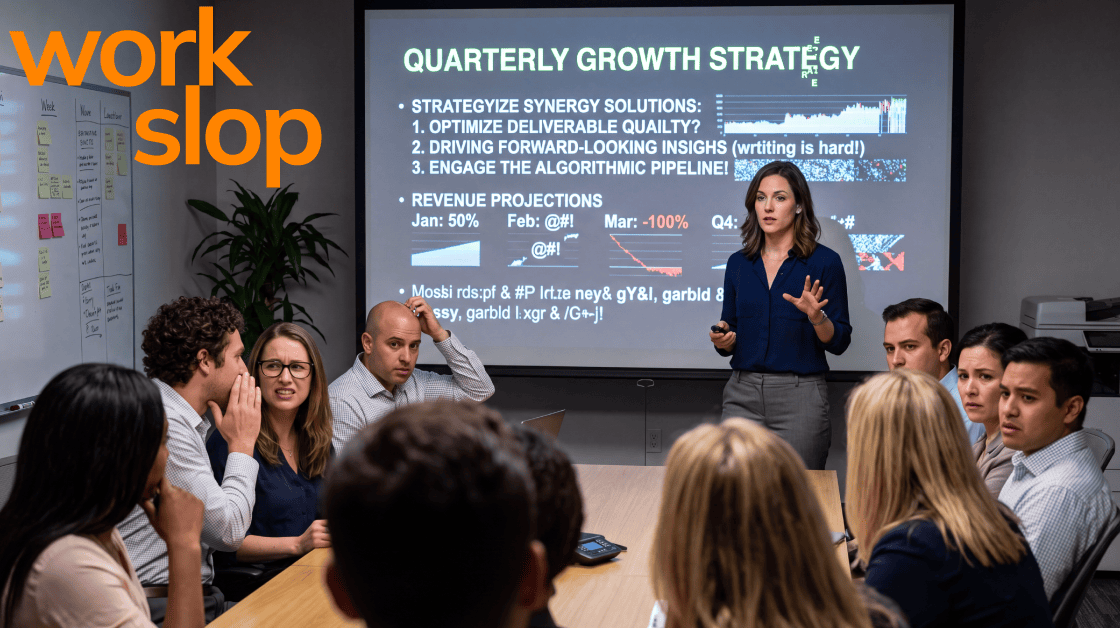
It’s probably happened to you – maybe even this week. A coworker sent you a presentation for review. When you opened the deck, it looked finished – clean formatting, confident bullet points, a chart that appeared to prove something. Ten minutes later, you still can’t say what it’s proving, let alone what it’s arguing. Neither can the person who sent it. Researchers at Stanford and the workplace coaching platform BetterUp gave this rising trend a name last year: workslop. It’s AI-generated work that looks complete on the surface and falls apart the moment someone actually tries to use it.
The Harvard Business Review study found that 40 percent of full-time U.S. employees had received workslop in the past month. Resolving each instance cost the recipient close to two hours. Scale that across a 10,000-person company and the researchers put the annual cost north of nine million dollars. None of that happened because someone sat down to write something bad on purpose. It happened because a tool got asked to finish a job that nobody actually owned.
Workslop Looks Like Work
Workslop rarely announces itself. It’s the report with impressive formatting and no real conclusion buried inside it. The code that runs on the first pass but nobody can explain why, including the person who wrote the prompt. A client email that reads warmly and commits to absolutely nothing specific. The polish is the problem, in a strange way. Bad human work tends to look bad – a rushed memo has typos and gaps you can spot in five seconds. Workslop is grammatically flawless and visually confident. That means the burden of catching it falls on whoever reads it next. By then, the person who generated it has usually already moved on to something else.
That burden has a real cost, even if nobody’s given it a name yet. A colleague opens the file and senses something is off. They spend the next ninety minutes reverse-engineering what the sender actually meant to say. More than half the people HBR surveyed said receiving workslop made them think less of the sender’s abilities. Over a third said it made them trust that colleague less going forward. AI was supposed to save everyone time. Instead, in this increasingly common scenario, it just relocated the work downstream. It added a layer of guessing on top of it.
Where the Habit Comes From
None of this is really about the technology itself. A language model does exactly what it’s asked to do, and it does it fast, which is precisely the trouble. When a team is stretched thin, the expectation often doesn’t change: still “produce five things today instead of two.” AI becomes the quickest route to something that resembles output. Nobody is cutting corners out of malice. Most people are responding rationally to a workload that has outpaced the hours available to do it properly. A tool that can produce something plausible-sounding in ninety seconds is an obvious release valve.
We’ve written before about the difference between a skills problem and a capacity problem. Workslop tends to sit right at that intersection. A team without enough bandwidth reaches for AI to manufacture more hours in the day. A team without the right expertise reaches for it to manufacture knowledge nobody on the team actually has. Both produce the same artifact: something that looks like a finished thought, but nobody accountable for the result ever actually thought it through.
A Fortune report on the underlying MIT Media Lab research found that 95 percent of corporate generative AI pilots show no measurable return on investment, and workslop is a strong candidate for one of the quieter reasons why. The tools themselves aren’t the failure point. The absence of anyone with real judgment sitting between the AI’s raw output and the person waiting on the other end usually is.
The Solution Is Ownership, Not a Ban
The instinct after reading numbers like that is to restrict AI use outright, and that’s probably the wrong lesson to take from it. TechCrunch’s coverage of the same research makes a sharper point: the problem isn’t the tool itself, it’s using the tool as a substitute for judgment instead of an extension of it. A skilled marketer who runs ten headline variations through AI and then picks the one that actually lands isn’t producing workslop. Someone who pastes in a prompt, skims the first output, and forwards it along without reading it closely probably is, whether they mean to or not.
That distinction – tool versus substitute – is exactly why an independent professional’s relationship with a client tends to hold up better than an internal blanket mandate to “use more AI” does. A freelancer’s reputation rides on every single deliverable they put their name on. They don’t get to shrug and blame the model for a report that doesn’t hold together, and most of the good ones know that better than anyone. A dedicated Customer Success Manager who matches a specialist into a stretched team isn’t only filling a capacity gap. They’re putting someone accountable for the finished product back into the process, AI-assisted or not.
Fix the Deliverable, Not the Deadline
The teams handling this well aren’t the ones banning generative tools outright. They’re the ones being explicit about where AI belongs in the workflow, and more importantly, about who’s actually on the hook once a piece of work leaves the draft stage and lands in someone else’s inbox. That’s a harder conversation than simply saying “don’t use AI,” and it’s also the more useful one, because the honest version of this problem was never really about the software in the first place.
It’s the same pattern we’ve already seen play out in quiet cracking: a team that looks fine from the outside while something underneath it quietly stops holding together. Workslop is just the paper trail that pattern leaves behind. The fix isn’t more caution around a piece of software. It’s making sure the person attaching their name to the work actually did the work, whatever mix of human judgment and AI assistance got them there. Bring in flexible, vetted talent to own the deliverable, and AI stops being the excuse. It just becomes one more tool a professional already knows how to use well.

FlexTal is the #1 flexible talent matching platform. Every day, we match organizations with pro-level independent contractors for flexible hourly and project-based engagements. Match with the Right Pro, Right Now.