
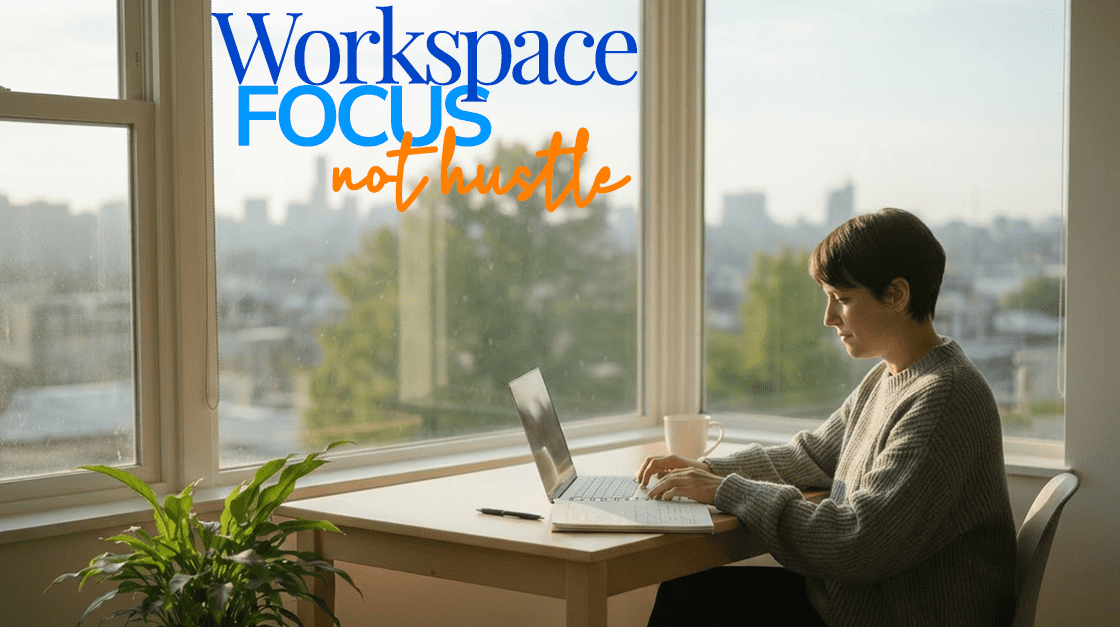
Why Calm, Intentional Work Environments Are the Real Productivity Hack in 2026
Somewhere along the way, productivity got loud. And the idea of a workspace that supports focus got complicated.
Standing desks slid from tech-savvy badge of honor to boilerplate expectation. Slack notifications became a cacophony of noise akin to a spastic metronome. “Always on” stopped sounding like a warning and started showing up as a job requirement. And before anyone really noticed, the modern workspace stopped being about helping people think – and started being about proving they were busy.
But here’s the quieter truth most high-performing teams already understand: hustle doesn’t scale. Focus does.
As we head into 2026, more organizations are reexamining what their workspaces are actually designed to support. Not just where work happens, but how it happens. Not speed for speed’s sake, but clarity, creativity, and sustained energy over time.
That shift matters whether your team is in-person or remote, real-time or async. Regardless of if your org-chart spans five time zones or blends full-time employees with flexible talent. Because environments that support focus don’t just feel better – they consistently produce better work.
Let’s talk about what it really means to design a workspace that supports focus, not hustle – and why this mindset is quickly becoming a competitive advantage.
The Problem with Hustle-Centric Workspaces
Hustle culture didn’t start out malicious. It grew from ambition, urgency, and the belief that hard work should be visible. Unfortunately, many workspaces evolved to reward motion instead of progress.
Open offices designed for collaboration became interruption factories. Digital tools meant to simplify communication multiplied into endless pings. And “flexibility” quietly morphed into an expectation that everyone should be reachable… always.
The result is teams that look productive on paper, but feel mentally wrung out by midweek.
Research continues to show that deep work – the kind that fuels strategy, innovation, and meaningful progress – requires uninterrupted time and cognitive calm. Yet many modern environments do the opposite. They fracture attention, compress recovery, and normalize burnout as the cost of doing business.
This isn’t just a wellness concern. It’s a performance problem.
When people spend their days reacting, context-switching, and guarding their calendars, the quality of their work declines. Over time, so does engagement – and eventually, retention.
Focus Is a Design Choice, Not a Personality Trait
One of the most persistent myths in modern work is that focus is purely an individual responsibility – something people should fix with better habits, stronger discipline, or the right productivity app.
In reality, focus is largely environmental.
People don’t struggle to concentrate because they lack willpower. They struggle because their environment makes concentration expensive. Every interruption has a cost. Each unclear expectation creates mental noise. Every unnecessary decision drains energy.
A focus-supportive workspace reduces friction instead of adding to it. It assumes people want to do good work – and then designs conditions that make that possible.
This applies just as much to digital environments as physical ones. In many cases, especially for distributed teams and organizations working with flexible talent, the digital workspace matters even more than the physical one.
What a Focus-First Workspace Actually Looks Like
A workspace that supports focus doesn’t need to be silent, minimalist, or devoid of personality. It doesn’t need to be on-site, in a group setting, or in an office building. And it certainly doesn’t look the same for everyone. It does, however, share a few defining traits.
First, it treats attention as a finite resource. Meetings are intentional, not reflexive. Communication norms prioritize clarity over immediacy. People aren’t expected to be responsive at all times – only at the right times.
Second, it creates psychological safety around boundaries. Blocking focus time, muting notifications, or saying “not right now” isn’t seen as uncooperative – it’s seen as doing the work well. Deep work isn’t a perk. It’s part of the job.
Third, it balances collaboration with autonomy. Not everything needs consensus. Not every question needs a meeting. People are trusted to own outcomes, not just activity.
Physically, this might show up as quiet zones, flexible seating, or home office support that prioritizes comfort and ergonomics over Instagram aesthetics. Digitally, it often means fewer tools used more intentionally, with clear expectations around when and how they’re used.
The common thread is simple: the workspace supports thinking, not just doing.
Why Focus Matters Even More with Flexible Talent
For teams working with freelance or flexible professionals, focus isn’t a nice-to-have – it’s foundational.
Flexible talent is typically engaged for high-impact, specialized work. Strategy. Design. Engineering. Marketing. Fractional senior-level positions. These roles depend on clarity, context, and uninterrupted thinking time.
When organizations plug freelancers into chaotic, hustle-driven environments, they rarely get the best of what that talent can offer. Context gets lost. Communication becomes reactive. Timelines stretch longer than expected – not because the talent isn’t capable, but because the environment is working against them.
When teams build focus-friendly systems, the opposite happens. Expectations are clear. Work moves forward asynchronously. Progress is measured by outcomes, not online status indicators.
This is especially critical for leaders managing distributed teams or blended workforces. A calm, intentional workspace creates alignment without micromanagement – and trust without constant oversight.
(Internal FlexTal Linking Opportunity: For Teams and Leaders Working with Flexible Talent)
Focus Is the Foundation of Sustainable Productivity
There’s a reason more organizations are shifting the conversation from raw output to sustainable productivity.
Burnout is expensive. Turnover is disruptive. And short-term gains fueled by overwork have a habit of collapsing at exactly the wrong moment.
A focus-first workspace acknowledges a simple reality: people aren’t machines. It builds in space for recovery, reflection, and high-quality thinking. Over time, that leads to better decisions, stronger execution, and healthier teams.
It also makes scaling far easier. When work is designed around clarity instead of urgency, adding new people – whether full-time or flexible – becomes smoother. Systems are documented. Priorities are explicit. Knowledge isn’t trapped in someone’s head or buried in a Slack thread from six months ago.
In other words, focus creates resilience.
Refreshing Without Reinventing Your Entire Setup
The good news is that supporting focus doesn’t require blowing everything up.
Most organizations don’t need a brand-new office layout or a sweeping culture overhaul. They need thoughtful adjustments that reduce noise and reinforce intentional work.
That might mean revisiting meeting norms, clarifying response-time expectations, or auditing which tools actually earn their keep. It could involve encouraging asynchronous updates, redefining “availability,” or simply giving people permission to protect their best thinking hours.
Small changes compound quickly when they’re aligned with how people actually work.
For growing teams, this approach is especially powerful. Instead of over-hiring to compensate for inefficiency, organizations can often unlock capacity simply by removing friction.
The Quiet Advantage Leaders Are Starting to Embrace
There’s something quietly confident about a team that isn’t rushed.
They move deliberately. Communicate clearly. Deliver consistently. And they don’t confuse urgency with importance.
As 2026 approaches, more leaders are recognizing that the real productivity edge isn’t found in doing more – it’s found in designing environments that help people do the right work well.
A workspace that supports focus sends a powerful signal. It says: we value thinking, not just activity. We trust our people. We’re building for the long term.
And in a world that’s constantly competing for attention, that kind of calm isn’t just refreshing – it’s strategic.

FlexTal is the #1 flexible talent matching platform. Every day, we match organizations with pro-level independent contractors for flexible hourly and project-based engagements. Match with the Right Pro, Right Now.